964 · 1603 · 1725
The same star, three times.
Before a photograph, the sky was a catalogue. Three of them still decide how this instrument speaks. A later plate does not retire the name. It is another way of looking at an object, or of reaching past the objects an eye could catalogue.
Vega is α Lyr in Bayer’s letters, and 3 Lyrae in Flamsteed’s numbers. On this field a harmonic of 42° is drawn around it and allowed to vanish. The mark is attention, not a seal.
964
al-Ṣūfī
Kitāb ṣuwar al-kawākib, the Book of Fixed Stars. A revision of Ptolemy’s Almagest, with magnitudes as he observed them. Each constellation is drawn twice: as on a globe, and as in the sky.
1603
Bayer
Uranometria, printed in Augsburg. Greek letters, roughly by brightness inside a constellation. That is why the field can say α Lyr.
1725
Flamsteed
Historia Coelestis Britannica. Stars numbered from west to east within each constellation. Vega is also 3 Lyrae.
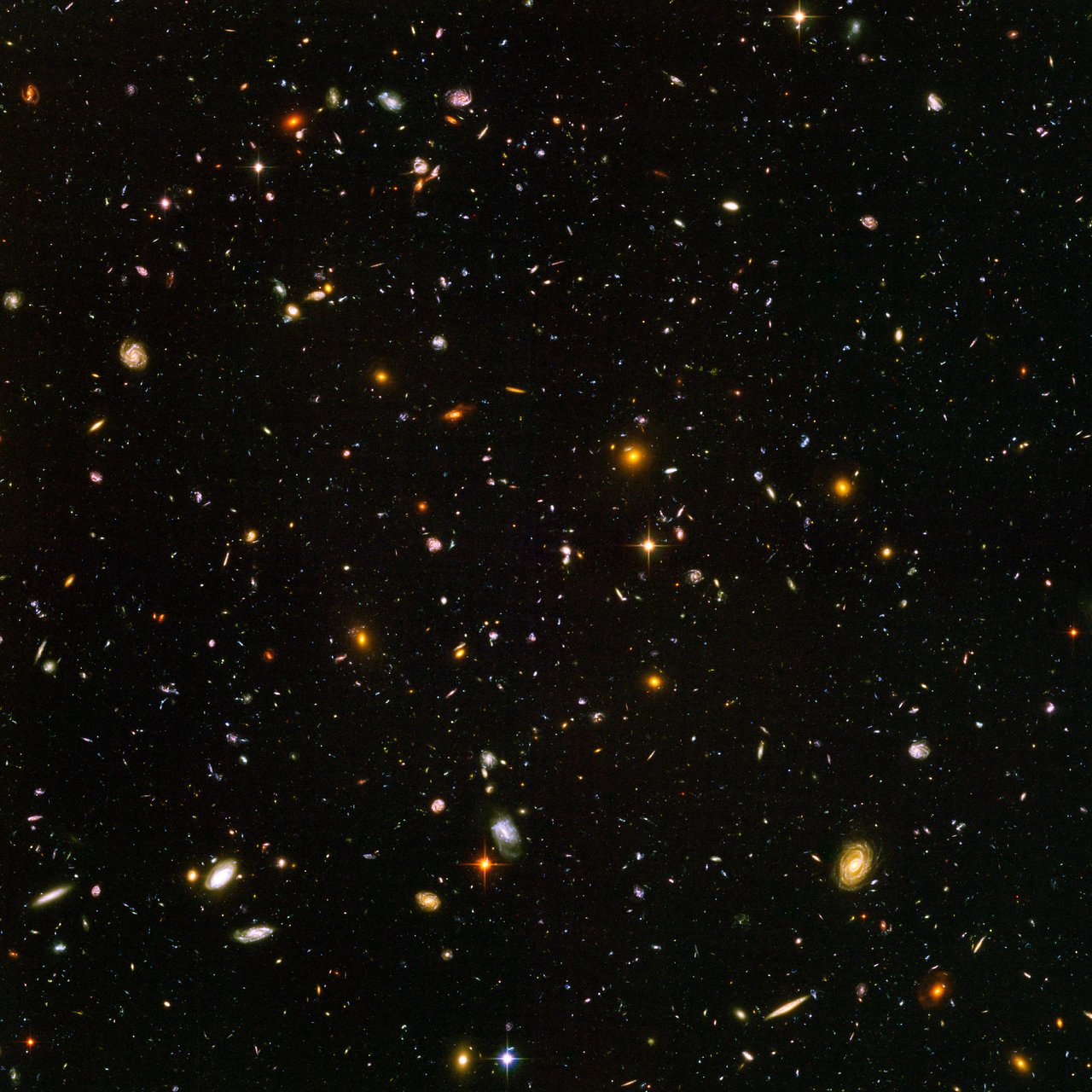
Deep field
Galaxies recorded beyond the catalogues.
Hubble Ultra Deep Field. NASA, ESA, S. Beckwith (STScI) and the HUDF Team.

Jupiter
Cloud bands and the Great Red Spot. The catalogues followed Jupiter as a wanderer.
JunoCam, 19 May 2017. Courtesy NASA/JPL-Caltech/SwRI/MSSS.

Venus
The ground, mapped by radar at 12.6 centimeters. Visible light stops at the clouds.
Magellan SAR, 12.6 cm, 1990–1994. Courtesy NASA/JPL-Caltech.